
Quick Takeaways
- Apical’s Sustainable Living Village (SLV) program combines smallholder training, farm documentation, alternative livelihoods, and forest conservation at village level. In 2025, 951 smallholders received GAP and BMP training, while 693 obtained STDB registration.
- Trigona honey provides participating families with an additional source of income that can be managed around their homes, reducing the need to enter forests or open new land.
For communities whose livelihoods depend on land and natural resources, economic resilience and environmental management are closely connected. In Aceh Singkil, this connection is especially important because villages, smallholder farms, forests, and areas within the wider Leuser landscape, including those near the Rawa Singkil Wildlife Reserve, form part of the same landscape.
Apical began the Sustainable Living Village (SLV) program in Aceh Singkil in 2023 to support this progress. Working across six villages, the program helps smallholders and participating families develop additional sources of income, improve farming practices, strengthen farm registration and documentation, and help reduce pressure on nearby forest areas. The program is delivered in collaboration with Yayasan Inisiatif Dagang Hijau (IDH), Yayasan Ekosistem Lestari (YEL), Forum Konservasi Leuser (FKL), and provincial and district government partners.

Why Sustainable Living Villages Matter in Aceh Singkil
Many families in Aceh Singkil depend on multiple sources of income, including oil palm farming, fishing, rumbia (sago) harvesting, forest products, and seasonal honey collection. When income is shaped by weather, seasons, and access to natural resources, planning ahead becomes difficult. Opening new land may appear to offer a solution, but it can also increase pressure on nearby forests and ecosystems.
A sustainable village approach looks at these challenges together. New sources of income can help families become more secure, while training and support can help farmers get better results from the land they already manage. It can also help them prepare the documents needed to meet growing demands for responsible and traceable sourcing. In this way, progress for families, farms, and the environment can move forward together.
How Apical’s Sustainable Living Village Program Works
Diversifying livelihoods through trigona honey
Trigona honey cultivation was introduced as an additional livelihood rather than a replacement for existing work. Stingless trigona bees can be managed near homes, allowing families to maintain colonies alongside farming and other daily activities. Participants receive mentoring on colony care, harvesting, product quality, and marketing.
The model also reduces the need to enter forests to collect wild honey or open new land for income-generating activities. Trigona bees support pollination in surrounding vegetation, creating a direct link between household livelihoods and the health of the local landscape.
One participating honey group reported that members earned around Rp350,000 to Rp500,000 in additional monthly income, depending on production, helping families meet school, household, and home-improvement expenses.
Improving farming practices and farm legality
SLV also supports independent smallholders through training in Good Agricultural Practices (GAP) and Best Management Practices (BMP). These cover practical areas such as harvesting, plantation maintenance, land management, and recordkeeping. Clearer records help farmers understand their own operations and make production easier to trace through the supply chain.
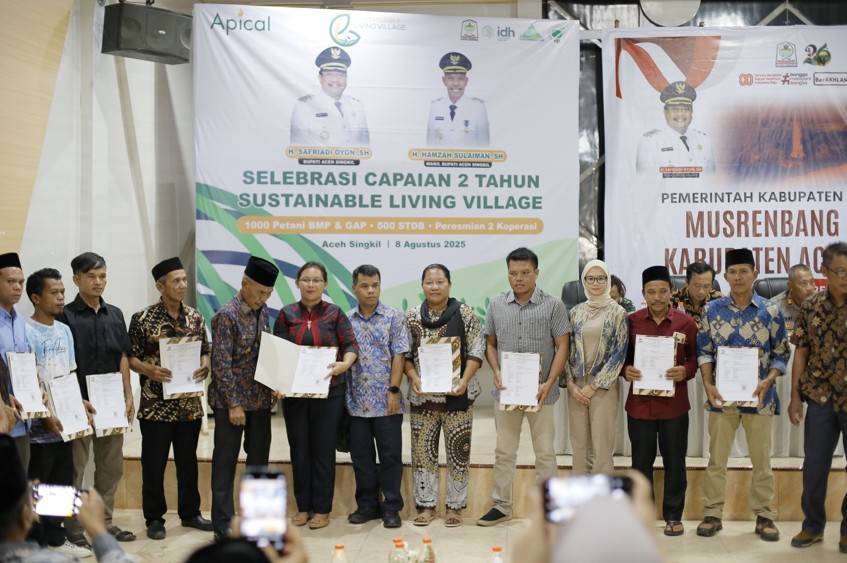
The program also assists farmers with Surat Tanda Daftar Budidaya (STDB), Indonesia’s cultivation registration document for smallholder plantations. The process requires farmers to provide information about themselves, their land, and their farming activities, which can be difficult to prepare without support. Once issued, STDB provides official administrative proof that the plantation has been registered. It can also strengthen farmers’ readiness for government programs, traceability requirements, and future sustainability certification.
Connecting community action, ecosystems, and partnerships
SLV connects field-level action with broader support across the landscape. Each partner contributes a distinct role: Apical and IDH guide the program; YEL works directly with communities; FKL provides conservation expertise; and local government coordinates activities and aligns them with local needs. Together, these contributions make the program practical, relevant, and easier to sustain.
This matters because stronger livelihoods, better land management, and more responsible supply chains cannot be built by one organization alone. Progress depends on trust, local participation, and support that responds to the realities families and farmers face every day.
2025 Progress in Aceh Singkil
Apical reported measurable progress from the Aceh Singkil program in 2025:
- 951 smallholders received training in Good Agricultural Practices (GAP) and Best Management Practices (BMP).
- 693 smallholders obtained Surat Tanda Daftar Budidaya (STDB) registration.
- 61 farmers received support for honeybee cultivation.
- Two cooperatives were established.
These results reflect progress across several parts of the program, from smallholder training and farm registration to stronger community organization and additional sources of income. Apical’s 2025 Sustainability Report places SLV within its wider work to protect landscapes and support smallholders and communities in Aceh Singkil and East Kutai.
What’s Next for Sustainable Living Villages
SLV’s long-term value will depend on whether its early gains can be sustained. Farmer groups will need to keep honey cultivation active, and smallholders will need to continue applying GAP and BMP practices in their daily farm management. Cooperatives and local partners will also be essential in helping farmers maintain records, access better markets, and coordinate the program’s next phase.
The experience in Aceh Singkil shows that sustainable development can begin with practical, incremental steps rather than a single large intervention. Additional household income, improved farming practices, clearer farm documentation, and better land management can reinforce one another over time. As these changes become part of daily life, they can help strengthen communities while supporting a more responsible and transparent supply chain.
Frequently Asked Questions
What is Apical’s Sustainable Living Village Program?
Apical’s Sustainable Living Village (SLV) program is a community-based initiative that links stronger livelihoods with better farming and forest protection. It combines smallholder training, farm documentation, new sources of income, conservation, and local partnerships.
Why is Apical’s SLV program implemented in Aceh Singkil?
Apical’s SLV program is implemented in Aceh Singkil because many families depend on farming, fishing, forest products, and other natural resources. Aceh Singkil also forms part of the wider Leuser landscape and includes communities located near important forest and conservation areas such as the Rawa Singkil Wildlife Reserve. The program helps communities improve their livelihoods while managing the surrounding landscape more responsibly.
How does Apical’s SLV program use trigona honey to support livelihoods?
Apical’s SLV program supports trigona honey cultivation as an additional source of income for families in Aceh Singkil. The stingless bees can be kept close to homes and managed alongside other work without opening new land. Trigona bees also pollinate nearby plants, helping support vegetation and biodiversity.
What are GAP and BMP in Apical’s SLV program?
Good Agricultural Practices (GAP) and Best Management Practices (BMP) are practical farming methods taught through Apical’s SLV program. The training covers harvesting, plantation care, land management, fertilizer use, pest control, and recordkeeping. These practices help smallholders manage their existing farms more effectively and keep clearer production records.
Why is STDB important in Apical’s SLV program?
Surat Tanda Daftar Budidaya (STDB) is the government registration document for a smallholder plantation. Apical’s SLV program helps farmers prepare the personal, land, and farming information required to apply. STDB provides an official record of the plantation and gives the supply chain clearer information about where produce comes from.