


Our 5Cs Business Philosophy

Doing what's good for our

Community
Country
Climate
Customer
Company

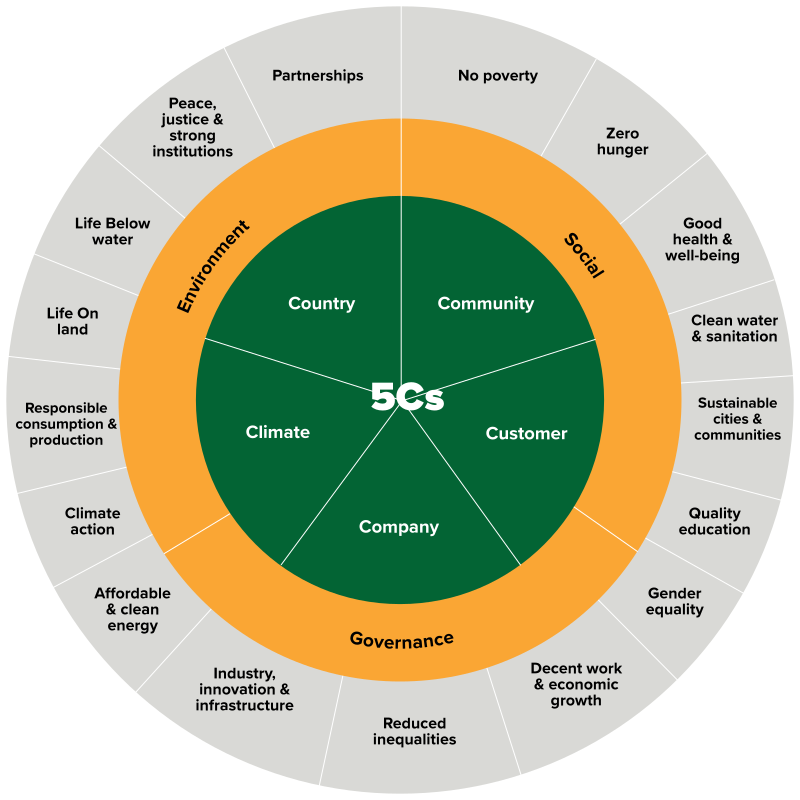
Apical is guided by Sukanto Tanoto’s 5C’s business philosophy of doing what is good for the Community, Country, Climate, and Customer, and only then will they be good for the Company. We also place emphasis on the three pillars of ESG – environmental, social, and governance.

We are committed to play our role as a responsible global corporate citizen and are therefore committed to supporting the United Nations Sustainable Development Goals (UN SDGs), introduced in 2015 as a common framework for governments, businesses and society to build a better world by 2030.

Apical ensures all activities are aligned with our 5C’s business philosophy, UN SDGs and ESG pillars. We identified nine UN SDGs, which are segmented into core and catalytic goals, where we are able to support, progress and make a positive impact.

Core goals are those that have the strongest alignment with Apical’s operations and sustainability commitments while catalytic goals are those which Apical sees as an opportunity to support the communities where we operate.
Governance

At Apical Group, our commitment to sustainability stems right from the top. Apical’s President is supported by the Executive Director, Director of Sustainability and various business heads to ensure sustainability is integrated into various roles within business and functional units, and embedded in the company’s core values and initiatives.

Sustainability topics are discussed at Board meetings held twice a year. We also have dedicated Sustainability teams based in Kuala Lumpur, Malaysia, and Pekanbaru, Dumai, Medan, Jakarta and Balikpapan in Indonesia. The Sustainability teams are tasked with implementing and monitoring our commitments through constructive stakeholder engagement and collaboration.

Supporting the United Nations Sustainability Development Goals (UN SDGs)

While we have identi­fied nine priority goals to focus on, we recognise that all 17 SDGs are interconnected and we may indirectly support the other goals through our activities. Our corporate social responsibility activities are aligned with the UN SDGs.

How we are improving lives

Mangrove Restoration

Apical is actively contributing to the protection and restoration of coastal ecosystems within its areas of operations. Since 2021, a total of 17,600 mangrove trees have been planted in Marunda, North Jakarta, helping to strengthen coastal resilience and support biodiversity in the area. In Dumai, Riau, Apical has also planted 6,000 mangrove trees since 2022, further extending its efforts to preserve vital coastal habitats. These initiatives reflect Apical’s commitment to environmental stewardship and its broader goal of fostering sustainable ecosystems for future generations.

Responsible Sourcing

To protect our environment and conserve natural resources, it is imperative that we adopt responsible production and consumption practices. To provide our customers and consumers with the confidence that our products are made from palm oil that have been responsibly sourced, we have developed a sourcing policy which Apical and its suppliers are required to adhere to and implement. Through our traceability and engagement programmes, we also work with our suppliers on adopting best practices.

Renewable Energy

As the world increasingly embraces greener alternatives, renewable fuels are becoming essential in powering transportation and supporting modern economies. Our expansion into the Sustainable Aviation Fuel (SAF) market, in partnership with Moeve (formerly Cepsa), highlights our commitment to transforming waste and residues into valuable resources. This collaboration is a key step in driving the global transition toward sustainable aviation.

Additionally, we are exploring advanced technologies that enable the conversion of palm oil waste and residues into second-generation (2G) biofuels, with plans to incorporate these into our operations. We are also providing guidance to our supplying mills on collecting greenhouse gas (GHG) emissions data and encouraging them to adopt mitigation measures to reduce GHG emissions. Through these efforts, we are making a meaningful contribution to a more sustainable and environmentally conscious future.

Labour Practices

Apical is committed to providing decent work opportunities, respecting human and labour rights, and maintaining a safe work environment. We also work closely with our suppliers through our Anchor programmes to ensure positive labour practices within our supply chain.

Find out more about our Anchor programmes here in A-SIMPLE Framework.

SMILE PROGRAMME

The SMILE (Smallholder Inclusion for Better Livelihood and Empowerment) programme is a collaboration between Asian Agri, Apical, and Kao Corporation. SMILE aims to support smallholders and promote a sustainable palm oil supply chain. Launched in 2020, it provides training and knowledge-sharing to help independent smallholders enhance productivity, manage land responsibly, and meet sustainability standards. By connecting smallholders to responsible markets, SMILE enables better yields, stronger cooperatives, and lasting community growth. With over 4,000 smallholders engaged across North Sumatra, Riau, and Jambi, the program is aiming to reach 5,000 smallholders by 2030, driving positive change and fostering long-term sustainability in the palm oil industry.

Sustainable Living Village Program

We are committed to enhancing the sustainable livelihoods of smallholder farmers through the Sustainable Living Village (SLV) program, which emphasizes a balance between socio-economic impact and environmental protection. SLV provides training in Good Agricultural Practices (GAP) and Best Management Practices (BMP) and assists farmers in obtaining the Cultivation Registration Certificate (STDB). The program began in Aceh Singkil in 2023, in collaboration with the Green Trade Initiative Foundation (IDH), the Sustainable Ecosystem Foundation (YEL), and the Leuser Conservation Forum (FKL). This program also encourages farmers to reduce forest activities by developing alternative income sources through Trigona honey cultivation. In 2024, SLV was launched in Kutai Timur, East Kalimantan, in partnership with the Earthworm Foundation to support farmers in developing cocoa as an additional livelihood.